

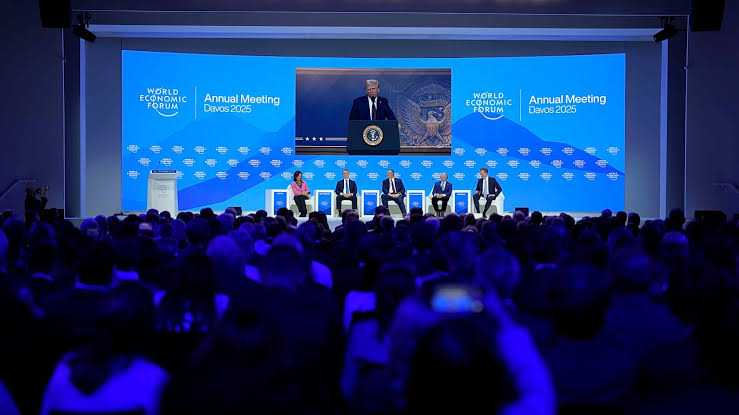
A dramatic confrontation at the World Economic Forum in Davos revealed how quickly trade disputes can turn into geopolitical crises. As the United States and Europe clashed over tariffs, world leaders faced an uncomfortable question: Is the era of predictable global trade coming to an end?
The announcement that unsettled Europe
In January 2026, the World Economic Forum in Davos became the center of an unexpected international confrontation.
Just days before the gathering, U.S. President Donald Trump announced plans to introduce additional tariffs on eight European countries, including Germany, France, Denmark and the United Kingdom.
The proposed measures involved a 10% import tariff beginning February 1, with a possible increase to 25% on June 1.
But unlike a traditional trade dispute, this confrontation was not primarily about industrial competition or trade deficits.
It was connected to Greenland.
Trump wanted greater American control over the strategically important Arctic territory, while Denmark and its European allies insisted that Greenland's sovereignty could not be negotiated under economic pressure.
Why the Greenland dispute became a global economic issue
Greenland occupies a strategically significant position in the Arctic, a region attracting growing international attention because of security, shipping routes and mineral resources.
The Trump administration argued that stronger American influence in the region was necessary for national security.
European leaders, however, viewed the tariff threats as an attempt to use economic power to influence the political decisions of allies.
The disagreement demonstrated how closely international trade and geopolitical interests have become connected.
A territorial dispute thousands of miles from major financial centers suddenly threatened to affect manufacturers, exporters and investors across two continents.
Europe considers its response
European Commission President Ursula von der Leyen warned against escalating the confrontation.
Speaking in Davos, she emphasized the importance of maintaining transatlantic cooperation while protecting European sovereignty.
European officials also considered possible retaliatory trade measures.
For businesses, the uncertainty created an immediate challenge.
Companies involved in international trade depend on predictable import costs, stable supply chains and long-term agreements.
Even the threat of additional tariffs can influence investment decisions and financial markets.
An unexpected reversal in Davos
On January 21, the situation took a surprising turn.
Following discussions with NATO Secretary General Mark Rutte, Trump announced that he would not proceed with the planned February tariffs.
He described progress toward a framework for future cooperation concerning Greenland and Arctic security.
The announcement eased some immediate fears of a wider trade confrontation.
However, the details of the proposed arrangement remained uncertain, and Denmark continued to insist that Greenland's sovereignty must be respected.
The tariffs were withdrawn before their scheduled implementation, but the political tensions revealed by the dispute did not simply disappear.
What Davos revealed about the future of global trade
The events highlighted a broader transformation taking place in international economics.
For decades, governments and companies operated under the assumption that global trade would continue expanding through increasingly interconnected markets.
Today, those assumptions face new challenges.
Trade restrictions, strategic competition, technological independence and national security considerations are increasingly shaping economic policy.
For companies, this may mean diversifying suppliers, reconsidering overseas investments and preparing for sudden changes in international regulations.
For governments, the challenge is more complicated: protecting national interests without damaging the economic partnerships on which prosperity depends.
A new world order is taking shape
The 2026 Davos confrontation demonstrated that tariffs are no longer discussed solely as economic instruments.
They can also become powerful tools of diplomatic pressure.
Trump's decision to withdraw the proposed Greenland tariffs prevented an immediate escalation, but it also exposed how vulnerable international relationships can become when trade and geopolitics collide.
The coming years may bring new agreements, shifting alliances and greater competition between major economies.
The biggest question emerging from Davos is no longer simply who will win the next trade dispute. It is whether the world's leading economies can preserve cooperation in an era when economic power is increasingly used as political leverage.
And that question could shape the future of global business far beyond the mountains of Switzerland.
Share this article